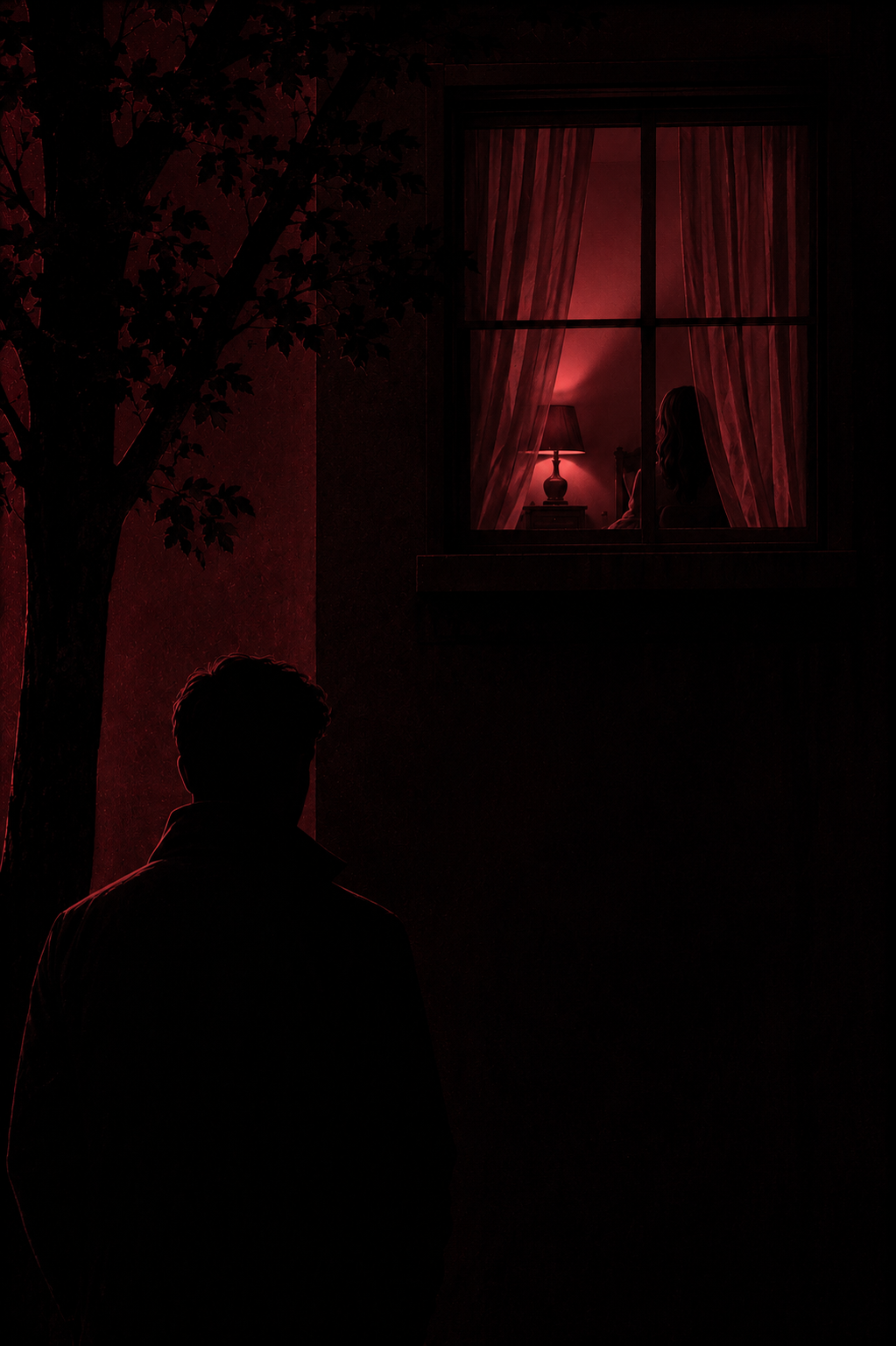
Watching You: Part 1 – Chapter 2 – Truth Underneath It
I’d been trying to imagine her voice for about a week.
I was wrong.
The brain casts people before they’ve spoken, and mine had gone with something quieter than what showed up – lower, slower, the kind of voice that matches a girl who reads at bus stops and apologizes to dogs. That’s not what I got.
I heard it for the first time in the morning. She was on the porch, talking to a delivery man. I couldn’t make out the words. Distance, wind, a lawnmower two houses down.
But I heard the shape of it – easy, unguarded, the specific tone of someone who hadn’t learned yet that being nice to a stranger costs something.
Hoarse, underneath the ease. I’d guess she hadn’t spoken to anyone else that morning. I was starting to notice that about her – how much of a day could pass before she used her voice on a single other person, and how she gave the first use of it away for free to whoever happened to be standing there.
That morning it was him.
The delivery man laughed at something she said.
Too loud for whatever the joke had been.
Some people laugh with a room. He laughed at it – at her – and there’s a difference between those two sounds that most people never learn to hear, because most people are never given a reason to.
He was standing too close.
Not obviously. Nothing a passerby would flag.
Just close enough that he’d have had to take a real step back to make it look accidental, and he hadn’t taken it.
The door was open too wide behind her.
I walked over.
Not to her. I came up the walkway with the specific, unhurried pace of someone who has every right to be there, and asked if he had anything for me.
He looked at his clipboard. Asked the name.
I gave him mine.
He checked.
I already knew he wouldn’t find it, because there was nothing to find – no parcel, no order, nothing waiting on a truck anywhere in the state with my name on it.
I watched him run his finger down a list that didn’t have me on it and felt no particular urgency about the fact.
“Nothing here,” he said.
“Huh,” I said. “Must’ve gotten my days mixed up.”
That was it.
That was the entire content of the lie.
I didn’t need it to hold up under scrutiny. I needed exactly ninety seconds of a reason to be standing on that porch that wasn’t her, and a nonexistent parcel gave me that far more efficiently than the truth would have.
He looked over at me while he closed the clipboard.
I’ve seen that look before. I disliked it then too.
It isn’t desire – desire is a fairly honest thing, as human failings go, it wants what it wants and mostly says so.
This was quieter than that.
Calculating.
The specific look of a man doing inventory on a house that wasn’t his – how wide the door was, how empty the street looked at ten in the morning, how long a girl standing three feet away might take to notice something had gone wrong before it already had.
I know what that look is because I’ve worn a version of it myself.
He held my eyes for maybe two seconds.
I smiled.
He looked at me. Then at the door. Then back at me.
Something in his shoulders changed – small recalibration, the kind a body does when it’s just been told something it wasn’t expecting and doesn’t want to admit it heard.
He said something short to her and stepped off the porch faster than a missing parcel required.
She was still smiling. Still thanking him for checking. Still holding the clipboard she’d signed for someone else’s delivery, entirely unaware that the last ninety seconds on her own porch had had almost nothing to do with her at all.
People miss entire conversations when nobody says a word out loud.
She’d just missed one, six feet away, conducted entirely in the space between two men who understood each other without either of them opening their mouths beyond a fake name and a made-up excuse.
He got back in the van.
I stayed on the porch a moment longer than the lie required too, then said something about checking with the neighbors, in case my parcel had ended up there instead.
She said okay. Didn’t ask any more questions.
Why would she – a stranger’s polite explanation is the least suspicious thing in the world, if you’ve never been given a reason to suspect polite explanations.
I walked back down the steps.
The door stayed open another thirty seconds after that.
Long enough for someone else.
Then she went inside, and the door closed, and the street went back to looking like nothing had happened on it, which – as far as she was concerned – was true.