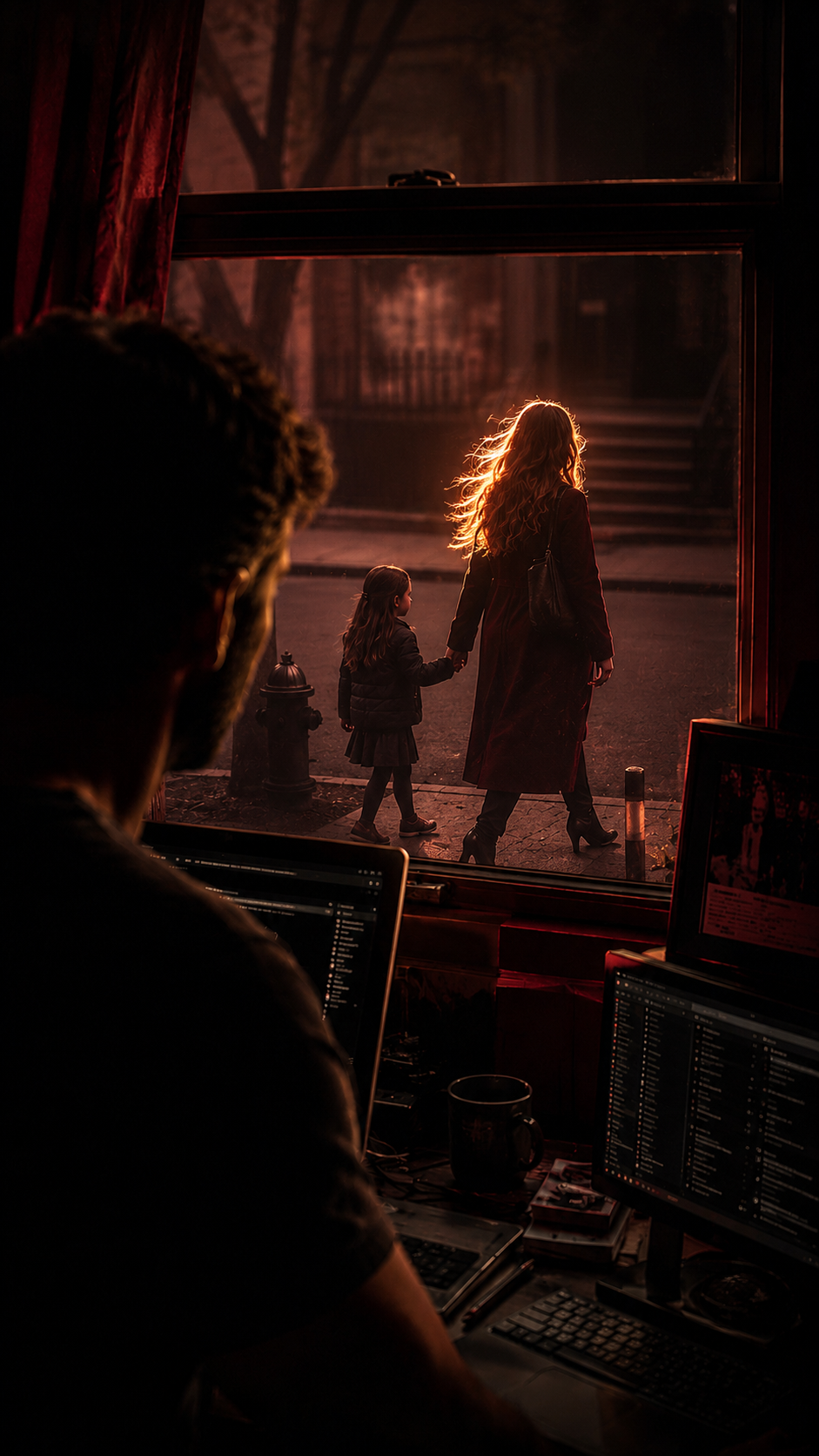
Sun In Her Hair – Chapter 2 – Not Single
Knowing about the husband should have ended it.
That’s not what happened.
What happened is I started building a second file to go with the first – not is she single anymore, but is she happy.
Which is a worse question to be asking about a stranger, and I knew it while I was asking it.
I watched for the wrong things.
Whether he walked with her or ahead of her. Whether she carried the kid’s bag or he did. Whether she looked at him when they talked, on the rare Sundays he was actually there.
Most days it was just her and the girl, same as always, and I told myself that was normal – plenty of husbands work. I had no evidence he was anything but a man with a job.
I built a story anyway, because I wanted one to exist.
Worse, I knew I was doing it.
I kept doing it.
By March I’d stopped pretending the window was incidental.
I started timing my breaks around it.
Told myself it was good practice – get up, stretch, look outside, the kind of thing productivity blogs recommend for people who sit twelve hours a day in front of code. That’s the version I’d have given you if you’d asked.
The real answer is I wanted to see if the light still did that thing in her hair, and productivity had nothing to do with it.
I was going stir crazy besides. A person can only stare at the same four walls for so many consecutive sixteen-hour days before the walls start staring back.
So on a Thursday, deadline technically met, brain technically fried, I did something I hadn’t done in longer than I’d like to admit – I left the apartment in daylight, on purpose, for no reason related to groceries.
There’s a park two blocks over. Small, nothing special, a coffee cart at the entrance that does a decent job for what it is.
I told myself I was going for the walk. I ended up in line at the cart instead, which should have told me something about how much I trusted my own explanations by that point.
I was on my sixth coffee of the day. Nobody needs a sixth coffee.
I got in line anyway, and it was only once I was standing there, wallet already out, that I noticed who was three people ahead of me.
Her.
In person.
Not through glass, not from thirty feet up and across a street – close enough to see that the coat I’d been watching for months had a coffee stain on the left cuff, small, old, the kind you stop noticing on your own clothes.
Close enough to hear her tell the girl to stop climbing the railing, in a voice that had clearly said the same sentence four hundred times and expected to say it four hundred more.
She wasn’t what I’d built. That’s the thing nobody tells you about watching someone from a distance – you don’t actually learn anything about them, you just get really familiar with the story you’ve invented to fill the gaps.
The window version of her was quiet, a little sad, assembled almost entirely from things I’d made up.
The real one was mid-sentence with a toddler about railing safety, sounding tired and unglamorous and completely uninterested in being anyone’s private weather system.
I bought the coffee anyway.
She turned around while she waited for hers. Ordinary polite stranger-in-line smile – the kind you give someone standing too close, not the kind that means anything.
I almost let it end there.
I’d like to say I hesitated out of restraint. Mostly I hesitated because I couldn’t think of a single normal sentence fast enough.
What came out was, “Is it any good? The coffee.”
Which is possibly the least interesting question a human being has ever asked another human being, and it worked anyway, because she laughed – a short, surprised sound, like the question was so unnecessary it looped back around to funny.
“Depends how desperate you are,” she said. “I’m on two today, so apparently desperate enough.”
“Six,” I said.
She blinked.
“You’re on your sixth?”
“I’m not proud of it.”
“You shouldn’t be.”
That made me laugh.
She smiled then – not the polite one from a second ago. A real one.
“You know they sell water too, right?”
“I’ve heard rumors.”
The girl tugged at her sleeve, already bored with adult conversation. She crouched to deal with whatever crisis had developed at knee height, and that was it.
I walked home with my sixth coffee going cold in my hand and no memory of drinking any of it.
I told myself it was nothing.
One question about coffee.
Thirty seconds, if that.
It didn’t feel like nothing.
It felt like the first real thing that had happened to me in longer than I wanted to think about, and I spent the rest of that afternoon doing worse work than usual, because some part of my brain had quietly reassigned itself to a different project.