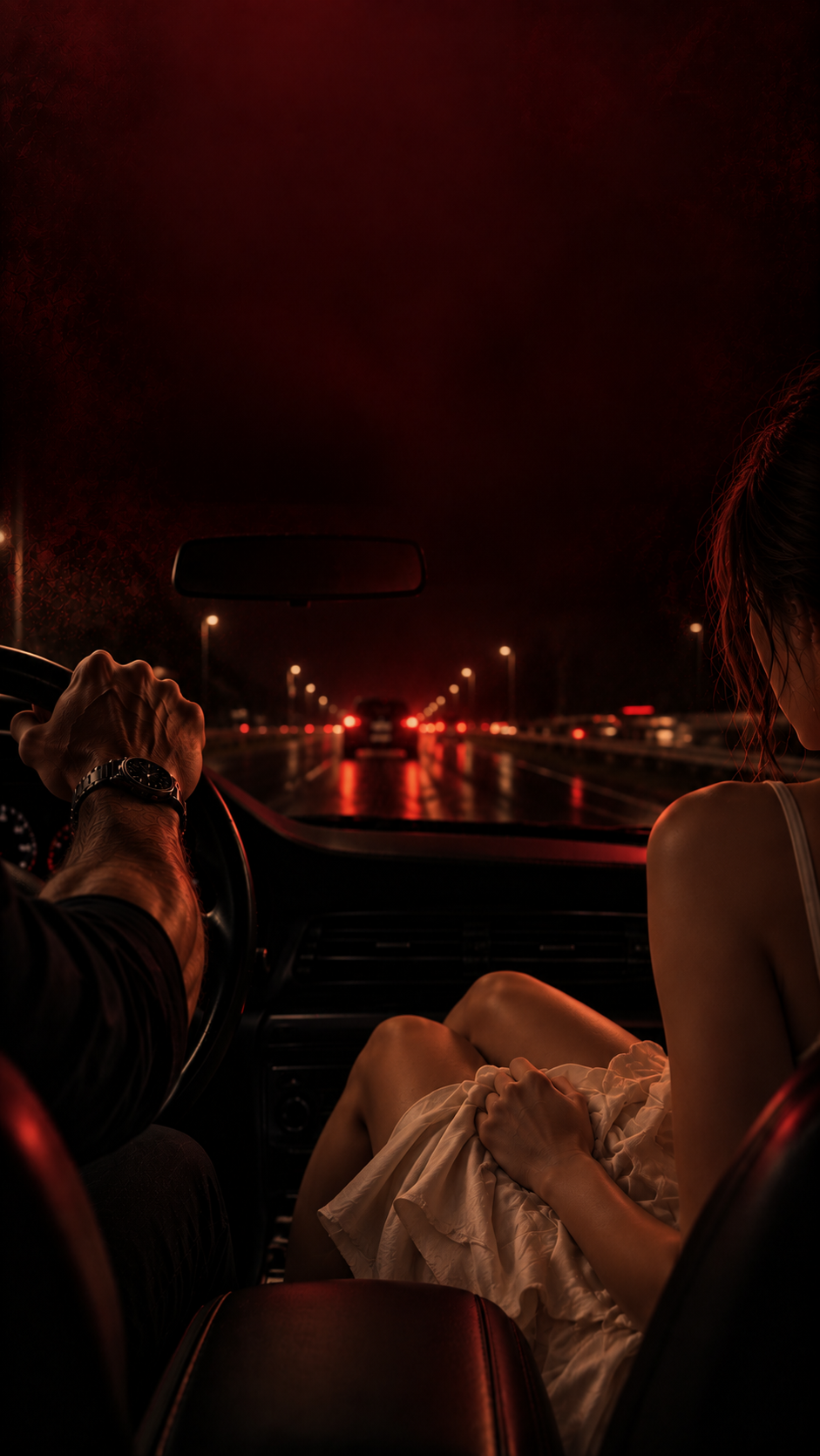
Wasted – Chapter 2 – Ride
For three days, Dane did nothing.
That was almost enough to make me forget the bar.
Saturday morning he made eggs. We argued about whether the carton of milk was still good. He threw it out; I took it back out of the trash because it was two days past the date and I have principles about wasting perfectly good dairy.
Sunday we went grocery shopping.
Monday night he fell asleep with one hand on my thigh while I watched something terrible on television and tried not to move because I liked the weight of it there.
Normal.
So normal that by Tuesday, the man at the bar had become exactly what he’d been before Dane said I noticed.
Nobody.
I should’ve known Dane wasn’t finished just because he’d stopped talking about it.
Tuesday night we went to his sister’s for dinner.
It ran late. His mother had brought photos from Portugal. His brother-in-law opened a second bottle of wine.
Dane didn’t drink because he was driving, and sometime around ten-thirty he put his hand on my knee beneath the table and squeezed once.
I looked at him.
“You ready?”
I was.
Nothing about him suggested anything was wrong.
That mattered later.
We said goodbye, walked to the car, and spent the first five minutes arguing pleasantly about whether his mother had intentionally taken forty-seven photographs of the same church.
“Forty-seven?”
“Minimum.”
“It was maybe twelve.”
“Dane, she showed us the bell from six different angles.”
“Architectural documentation.”
“Is she building a case against the bell?”
He laughed.
Then we reached the highway.
And he accelerated.
At first I didn’t think anything of it. Dane always drove faster than I liked.
Then we passed eighty.
I looked at the speedometer. Looked away. The conversation about his mother’s photographs had ended without me noticing.
Eighty-five.
“Dane.”
“What?”
Nothing in his voice.
That was when I understood.
Not Tuesday.
Friday.
The bar. The man whose name I hadn’t even learned.
You had fun tonight.
I noticed.
Three days of eggs and groceries and television, and I’d mistaken silence for forgetting.
Dane hadn’t forgotten anything.
He’d waited.
I turned toward the window.
I used to tell him to slow down. In the beginning, anyway. Slow down. Or once, half laughing because I hadn’t understood yet, you’re going to kill us both.
He’d gone faster.
Not wildly. Dane rarely did anything wildly. Just enough.
Enough to teach me that asking twice was a choice.
So eventually I stopped asking.
Crying took longer. That made him faster too. Not every time. That would’ve made it predictable.
Just enough times that eventually my body learned before my mind did.
Be still.
Don’t grab the door.
Don’t watch the speedometer.
Breathe through your nose.
And whatever happens –
don’t make a sound.
The exit came.
Dane took it hard enough that my body shifted against the seatbelt. My hand moved toward the door without permission. I caught it halfway and put it back in my lap.
Dane saw.
Of course he saw. He saw everything.
I stared through the windshield.
One tear got out anyway.
I hated that one most. Not because I was crying. Because I’d almost managed not to.
I turned toward the window before he could see it.
Too late.
His eyes flicked toward me. Then back to the road.
And he smiled.
Barely.
My stomach tightened.
But he didn’t accelerate.
This time, he slowed down.
Five miles an hour. Then another five. Until we were moving with traffic again.
I wiped my cheek without turning toward him.
Neither of us spoke.
And something stupid happened inside me.
Relief.
Not because the ride was over.
Because he’d noticed I was trying.
We got home a little after eleven. Dane put the kettle on without asking, which he almost never did, and started telling me some story about his brother-in-law’s golf swing like the last twenty minutes on the highway had happened to two other people.
I sat at the counter and let him talk, watching the line of his shoulders, still loose, still easy.
Dane set a mug down in front of me. Black tea, the way I take it, though I don’t remember ever telling him that.
He always knew things like that without being told. It used to feel like the safest kind of magic – being known that completely by someone who never once needed to ask.
He leaned against the counter across from me, arms crossed, watching me drink it.
“You’ve been quiet since the car,” he said.
“Have I”
Not a question. I’d started answering him in his own shape without noticing when that had begun either.
He didn’t smile, exactly. Something close to it. Something that made me put the mug down and hold very still, the same stillness from the highway, except now there was nowhere to look but at him.
“You know I can always tell,” he said. “When you’re pretending you’re fine.”
I opened my mouth – I don’t even know what I meant to say, some reflex to close the distance he’d just opened – and he was already moving, unhurried, like he had all the time he wanted.
I held still. Waited.
His hand reached past me instead, for the mug I’d left on the counter behind my shoulder, and he carried it to the sink without another word.
“Get some sleep,” he said, like nothing had almost happened at all.
I stood there a long moment after he’d gone.
Wanting, stupidly, for him to come back and finish what he hadn’t started.