Perfect Imperfection – Chapter 2 – Recovery
You can’t take a cab home after general anesthetic.
I found that out eight days before, on page three of the pre-op package, under a heading that said IMPORTANT in a font that looked like it was trying to be friendly about it. A responsible adult must drive you home and remain with you for the first 24 hours following your procedure. Taxis and rideshare services are not acceptable.
I read it standing in my kitchen. Then I read it again, like the second time it might say unless you’d really rather not.
I had a spreadsheet with four tabs. I had researched recovery times, scar placement, anesthesiologist reviews, and which pharmacy near my apartment was open latest. I had frozen eleven portions of soup. I had not once thought about how I would get home.
That’s not true. I’d thought about it. I’d just assumed I would figure it out later, which is what I’d been doing with Dana for four months.
I told her on the Wednesday. She came over with the wine she’d been promising since the car, and I let her get one full glass in before I said it, because Dana is a better listener with one full glass in her.
“I’m having surgery next Thursday.”
She put the glass down so fast it clicked on the table.
“What? What kind of surgery? Is it – oh my God, is it the lump thing? Your mom had the lump thing -“
“It’s not the lump thing.”
“Then what?”
I told her. Nose, eyes. The rest later. I’d practiced it in the shower so it would come out flat, like a grocery list, and it mostly did.
Dana didn’t say anything for a long time. She looked at my face. I let her. That was probably the hardest part of the whole year, if I’m honest, and nobody put me under for it.
“Erin,” she said finally. “You don’t need any of this.”
“I know.”
“No, I mean it. You don’t -“
“I’m not asking if I need it. I’m asking if you can drive me.”
She picked her glass back up. She drank some of it. She looked at the TV, which wasn’t on.
“What time?” she asked.
At work I said sinus surgery.
I had a deviated septum. I’d had one my whole life, and Dr. Halvorsen was going to fix it while he was in there, because apparently that’s how it works, like getting your oil changed while they do the brakes. So when Linda asked why I was taking two weeks, I said, “I’m getting my sinuses fixed,” and it was the truest thing I said to anyone that spring.
“Oh, my brother had that,” Linda said. “He snored like a bear after. Like a bear, Erin. His wife slept in the basement.”
“I’ll warn my wife.”
She laughed. Nobody asked anything else. People don’t ask follow-up questions about sinuses. It’s one of the least interesting parts of the body, which is maybe why I’d picked it.
The clinic waiting room is very white, with a very expensive couch nobody sits back on. On one side is a glass door into the hallway where the procedure rooms are. You can see yourself in it from almost every chair.
I sat in the one chair where you can’t.
Dana sat beside me, holding a coffee she wasn’t drinking, bouncing her leg. She’d taken the whole day off and hadn’t told me until that morning, when she showed up forty minutes early in sweatpants and said, “What? I have a lot of days.”
A nurse called my name. Dana squeezed my hand and then did something she’d never done in ten years. She didn’t make a joke.
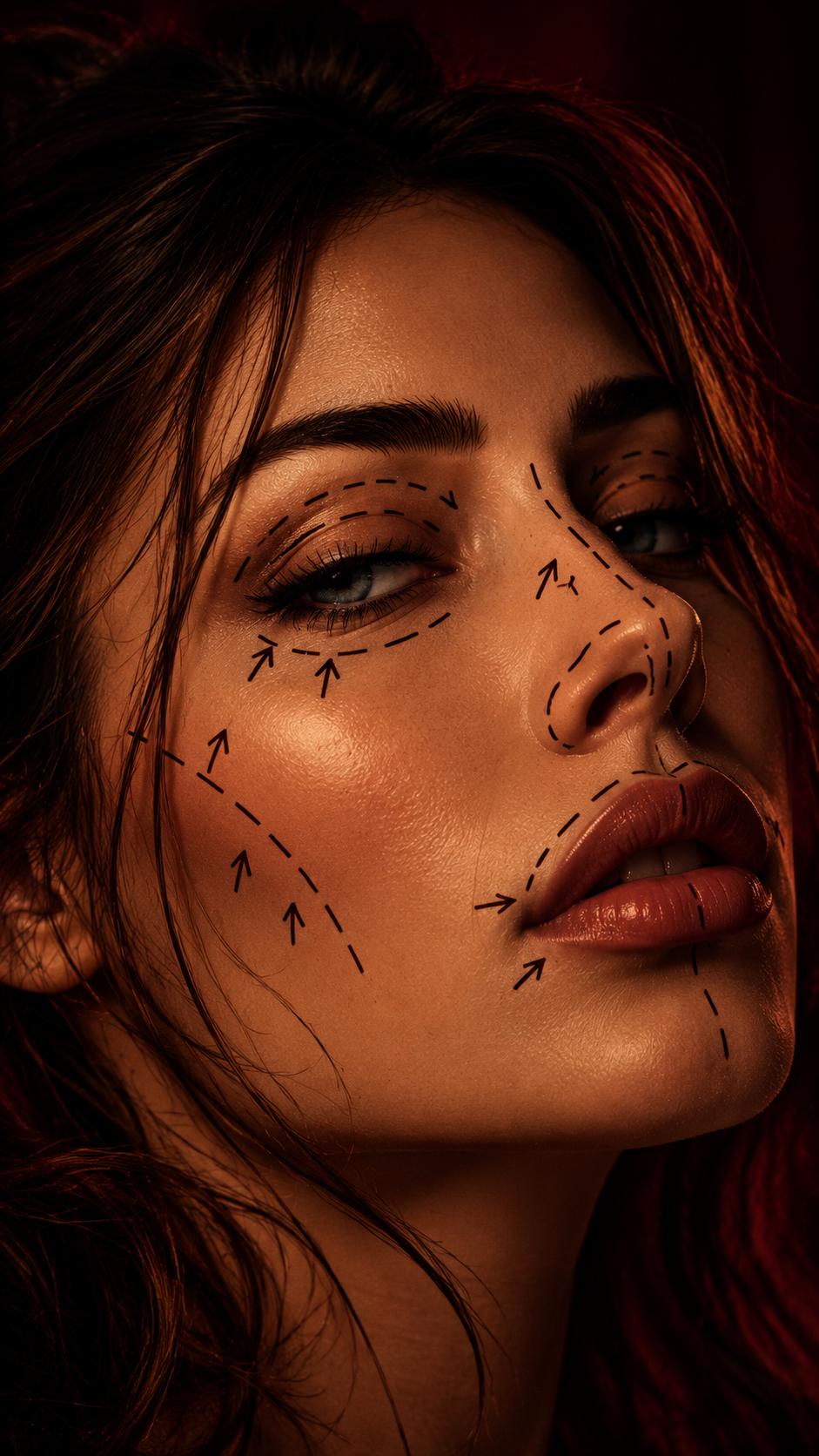
Upstairs, Dr. Halvorsen drew on my face with a purple marker while I sat on the edge of the bed in a gown that tied in places I couldn’t reach. He had cold hands and a wedding ring and the calm of a man who does this four times a day. He drew along my eyelids, down my nose, and a small cross at the tip.
He was the fourth surgeon I’d seen. The first three had all said something about my face in the first five minutes, in the tone you’d use to describe a kitchen that needed updating. Well, we’d definitely want to address this. One of them had shown me a tablet with his before-and-afters on it, and all the afters had the same nose. Like they came in a box.
Dr. Halvorsen had looked at me for a long time without saying anything. Then he’d said: “You don’t need the eyelids. But I understand why you want them.”
I’d put him in the spreadsheet that night. The notes column just said Yes.
“Any questions?” he asked now, capping the marker.
“No.”
“Nervous?”
“No.”
He smiled a little, like he’d heard that before and didn’t believe it then either.
In the operating room, the anesthesiologist asked me to count backward from ten.
I got to seven.
I woke up with Dana in the chair next to me, eating my apple juice.
“You’re awake,” she said. “You look like shit. Like, genuinely. Like a raccoon that lost a fight to a truck.”
I tried to say something and it came out as air.
“Don’t talk. Here.” She held up her phone and took a picture before I could do anything about it. “For the record.”
“Delete that,” I said, or tried to.
“Deleted,” she said, and put the phone in her pocket.
Nobody tells you what recovery is actually like. They tell you the facts.
Mild to moderate discomfort.
Swelling peaks at 48 to 72 hours.
They don’t tell you that you’ll sleep sitting up on four pillows for a week and wake up every hour with your mouth so dry your tongue sticks to the roof of it, because your nose is packed and you’ve been breathing like a dog.
They don’t tell you about the drip pad, a little folded square of gauze taped under your nose like a tiny hammock, which you change every hour, and which is always a colour you don’t want to look at.
They don’t tell you that crying hurts when your eyelids have been cut. Not emotionally. Physically. The tears sting in the stitches.
So on day two, when Dana put on the reality show with the drink-throwing women and one of them brought her estranged father to the reunion, I had to keep telling myself very firmly not to get into it.
“Are you crying?” Dana asked.
“No.”
“You’re crying at Crystal’s dad.”
“It stings. It’s a medical thing.”
“You’re crying at Crystal’s dad,” she said again, softer, and handed me a tissue, and then took it back, because I wasn’t allowed to touch my face.
She stayed three nights, not one. She slept on my couch, which is too short for her, with her feet hanging off the end. She set alarms for my pills. She put frozen peas on my eyes, and when the peas stopped being cold she ate them.
She didn’t say you don’t need this again. She didn’t say much about it at all. I kept waiting for it, and it didn’t come, and after a while I understood that was also something she was saying.
On the third night my phone buzzed on the coffee table.
u up
Jordan. Dana looked at the screen, then at me, then at the screen.
“Who’s Jordan?”
“Nobody.”
I typed: Out of commission for a while.
Which was true.
He wrote back: k
That was the last time Jordan texted me. A year. k. I kept waiting to feel something about that too.
For the first time in my life, I had a good reason not to look in a mirror.
Everyone agreed. Dr. Halvorsen’s nurse said the bruising could be “confronting” and I might want to “take it easy on the mirrors for the first week.”
Dana turned the bathroom mirror around by hanging a towel over it, like somebody had died. My whole life I’d been avoiding my reflection, and now I was supposed to, and there was something almost relaxing about it. Like finally being allowed to call in sick for a job you hate.
I texted my mother on day four: Had a small procedure, all fine, resting at home.
She was at my door on day five with a pot of soup and her coat still buttoned.
I watched her face do three different things in about a second when she saw me. Fear first. Then confusion. Then something that closed, like a door someone had been holding open.
“What procedure?” she asked.
“Mom -“
“What procedure, Erin?”
I told her. Grocery list. Flat.
She came in. She took her boots off very carefully, lining them up by the wall, the way she does when she’s angry and doesn’t want to be the kind of person who is angry. She put the soup on the stove. She looked at the eleven portions of soup already stacked in my freezer and put hers in anyway.
She stayed until dark. She cleaned my kitchen, which was already clean. She asked if I was in pain, and whether I had enough pillows. She asked if the doctor was a real doctor, and I said yes, Mom, he’s a real doctor. She didn’t ask why. I think she was afraid I’d tell her.
On day seven, the splint came off.
Dr. Halvorsen took it off with the same cold hands, pulled the tape away in strips, and looked at his work the way my mother looks at a cake she’s taken out of the oven. Critically. Tilting his head.
“Good,” he said. “Very good. It’s swollen, you’ll see. That’ll take a while.”
“How long?”
“The nose takes a year.”
“A year?”
“The last of it, yes. You’ll look very different in two weeks. You’ll look like yourself in about twelve months.”
He meant it as a comfort. I think.
My mother picked me up from that appointment, because Dana had to work and I still wasn’t allowed to drive, not that I had anything to drive. We didn’t talk much in her car. At a red light, she turned and looked at me properly, for the first time since the soup.
She looked for a long time.
“You had Grandma’s nose,” she said.
The light turned green.
“I know,” I said.
She drove me home.
In September I did the rest.
At work I said it was “a minor women’s procedure,” and that was the end of the conversation. Nobody asks a follow-up question about a women’s procedure. Linda gave me a card with a cartoon cat on it that said Hang in there! Kevin signed it Get well soon Ellen.
Recovery for the breasts was different. Less dramatic, more strange. I wore a compression bra that fastened up the front with a row of hooks and looked like something a nurse from 1953 would wear under her uniform. For a while I couldn’t feel much of anything across my chest. It was numb in a way that made me touch it all the time, just to check it was still me.
The first time I took a shower without the bra, I stood under the water and put my hands on my own breasts the way you’d hold something you just bought, before you’ve decided you’re keeping it.
They didn’t feel like mine yet. They felt like a present.
The lips were in November, on a lunch break. That was it. Numbing cream, a needle, ice, twenty minutes, back at my desk by one-fifteen with a slightly stiff smile. Linda didn’t even notice. The nurse said to come back every six months or so, like a haircut, and I put it in my calendar with a repeat on it, and that was the whole thing. Lips were the easiest. Lips were a lunch break.
I financed the last part over eighteen months. The payments came out on the fifteenth. I set those on repeat too.
The nose took a year. He was right about that. He was right about all of it.
For months, it was fine. Better. Swollen, then less swollen, then something I didn’t hate, then something I sometimes forgot to check. Which, if you’ve never had a face you check, you won’t understand is the whole point.
Then it was February.
I parked at work – I had a new car by then, used, grey, the kind nobody looks at twice – and walked to the office the way I always walk. Past the bakery on the corner. It was about 8:20, and the sun was low, low enough to do the thing it does from October to February, where it turns the whole window into a mirror.
I’d walked past that window hundreds of times. Probably thousands. My body knew exactly when to turn its face toward the street.
I didn’t turn.
I don’t know why. I think I was thinking about an invoice.
And there was a woman in the window, in my coat, holding my coffee, with the bakery’s bread racks behind her, going right through her like she was a ghost in her own reflection. She had a straight, small nose. Open eyes. A mouth that looked like it had something to say.
I’d planned to cry. I’d planned it for years. I just stood there and thought, oh.
There you are.
A man came out of the bakery with a paper bag and had to step around me. He said, “Sorry.” I said, “Sorry.” He looked at me. Not long. Just a little longer than people used to.
Then I walked the rest of the way to work, eleven surfaces, and didn’t avoid any of them.
At my desk, before I’d even taken my coat off, I opened my email.
Hi Tessa, I wrote. Is it too late to redo my headshot?
She wrote back in under a minute.
omg of course!!! come by whenever!!