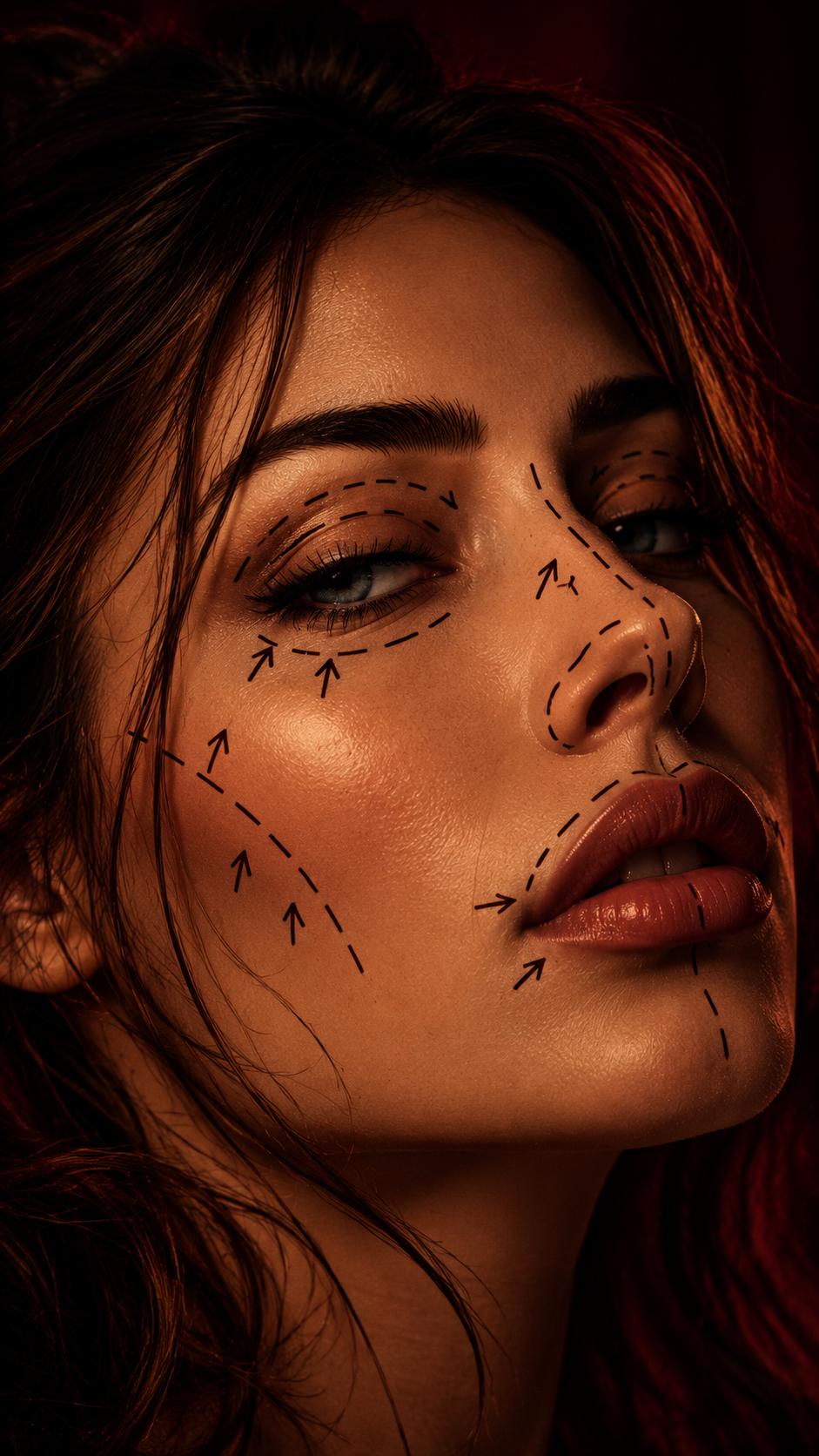
Perfect Imperfection – Chapter 1 – Reflective Surfaces
I know where every reflective surface is between the staff parking lot and my desk.
There are eleven. Twelve from about October to February, when the sun sits low enough to turn the bakery window on the corner into a mirror. I don’t avoid them in any dramatic way. I’m not a vampire. I just know where they are, the way you know which stair creaks in your parents’ house. Your foot goes around it before you’ve thought about it.
The elevator doors are the worst. Brushed steel, floor to ceiling, and they close slowly, so you get a good long look whether you want one or not. I face the button panel. I’ve pressed four a lot of times for someone who works on three.
The rest are easy. The dark TV in the boardroom: sit on the same side as the screen. The framed “Safety First” poster by the kitchen, which has glass over it for reasons nobody can explain: don’t stand there waiting for the microwave. The window beside Linda’s desk after four o’clock. The screen of my own monitor when it goes to sleep. I set it to never sleep. IT asked me about it once. I told him I didn’t like waiting for it to wake up.
Which was true.
The headshot email came out on a Monday.
Hi team! We’re refreshing the website with a new Meet the Team page. A photographer will be set up in the boardroom Thursday from 9 to 3. Business casual, and smile!
The exclamation marks were Marketing’s. Marketing was one person, Tessa, who was twenty-four and had a ring light on her desk for reasons.
I did the math right away. There were thirty-one people on the floor, and each photo would take maybe five minutes. If I went at 2:45, the photographer would be tired and want to go home. Tired people accept the third shot.
“You doing the photo thing?” Linda asked me on Wednesday. She was eating yogurt with a fork, which she did every day, and which I had never asked about, because that’s the kind of thing you ask about in the first week or never.
“I guess we have to.”
“I’m wearing my green,” she said. “It’s the only thing I own that doesn’t make me look like a thumb.”
I laughed. She meant it as a joke, and it was one. But she’d said it out loud, in the office, with yogurt, like it cost nothing. I remember thinking I’d never once been able to say anything like that. Not because I didn’t think it. Because if I said it, someone might look at me to check.
Kevin from sales stuck his head in at 2:40 on Thursday.
“Ellen, you’re up. She’s waiting on you.”
My name is Erin. Kevin has called me Ellen for two years. He called me Ellen at the Christmas party. He wrote Ellen on a birthday card that went around the office, in pen, and I signed under it.
I’ve never corrected him. Correcting him would mean he’d have to look at me long enough to learn it.
The photographer was younger than I expected, with purple nail polish and a camera the size of a small dog. She’d pulled the boardroom blinds and set up a grey backdrop and two lights on stands. The TV was on the wall behind her, off and black. I could see the backdrop in it. I could see the shape of someone standing in front of it.
I looked at the camera instead.
“Okay, just relax your shoulders. Chin down a little. Little more. Perfect.” Click. “Okay, and give me a real smile.” Click. “Oh, that’s nice.”
She turned the camera around to show me.
People do this constantly now. They take your picture and then they show it to you, like a gift. I’ve never understood it. If someone takes your blood, they don’t turn the vial around.
It was me. It was the face. Under studio lighting, which I learned that day is designed to find every single thing.
“Can we do another one?”
“Sure!”
We did nine more.
I asked her to try one with my body turned more to the side. Then one where I didn’t smile with teeth. Then one where I did, but less. I could feel her patience going. It was ten after three. She had a kid, or a dog, or a life, and she’d been saying “chin down a little” for six hours.
“I think we have some really good ones,” she said. Which meant please.
“The side one,” I said. “The first side one.”
She scrolled back to it. I was half in shadow. You could mostly see my hair.
“You sure? The front ones are really nice.”
“I hate cameras,” I said, and smiled, like it was a funny thing about me.
It was true. It was just true the way it’s true that a person who’s been in a car accident doesn’t love highways.
On Friday I went to Dana’s.
Dana has been my best friend since we were twenty-two and worked at the same terrible call centre. We sat next to each other for fourteen months, apologizing for internet outages to people who called us bitches. Her whole apartment is photographs. Not framed art. Photographs. The fridge is covered in them, three layers deep, held on with magnets from places she’s never been.
I’m on the fridge a lot. Or my shoulder is, and my hair. There’s one of us at a lake when we were twenty-four where I’m fully in it, laughing, mid-sentence, not ready. I’ve looked at it maybe twice in seven years. I know exactly where it is. Top right, under a pizza magnet.
“Okay,” Dana said, pouring wine into two glasses that didn’t match. “It’s reunion night. Everybody hates everybody.”
We watched a lot of the kind of show where women with incredible extensions throw drinks at each other in restaurants. Dana narrated. Dana always narrates.
“She’s so full of shit. Look at her. She knows she’s full of shit.”
Halfway through, she took a picture of us on the couch. She held the phone up high, which helps, and I did my usual thing where I tipped my head onto her shoulder so most of my face went behind hers.
She posted it before I could say anything. Friday night therapy. Two wine emojis.
“Can you untag me?”
Dana looked at me over her glass.
“You’re in, like, eleven percent of it.”
“I know. Can you just.”
She untagged me. She didn’t even sigh anymore. She’d stopped sighing around year four.
“You’re the only person I know,” she said, “who untagged herself from her own birthday.”
“It was a bad angle.”
“It was a cake.”
A new woman came on screen. She was maybe forty, maybe thirty, maybe sixty. There was no way to tell. Her face was very smooth and very still, and her lips looked like they belonged to someone slightly bigger.
“Oh no,” Dana said. “Oh, what did she do?”
“I don’t get why people do that to themselves,” I said.
I’d like to say I said it to throw her off. I didn’t. I meant it. I watched that woman’s face not move while she talked and I felt real, specific pity for her.
My phone was on the couch cushion between us, screen down. Open on it was a spreadsheet with four tabs. The first tab was called Consults. There were four surgeons on it, with prices, recovery times, and a column where I’d written notes after each appointment. Things like rushed and pushed fillers and photos on website look the same, all same nose??
The fourth row had no bad notes. The fourth row was Dr. Halvorsen.
Jordan texted at 11:40, which is when Jordan texts.
u up
We’d been doing this, on and off, for about a year. He was nice. He was a respiratory therapist who worked nights and wanted someone to lie next to when his schedule flipped. I didn’t love him. I don’t think he thought about me enough to love me, which I found restful.
His apartment was always dark. That was one of the things I liked. I’d come in, he’d be in bed already, and I could take my clothes off without any overhead light on me at all. I knew where to put myself. On my side, facing away from the bathroom, because the bathroom door had a mirror on the back of it and he never closed it all the way.
He never once asked to turn the light on.
I thought that was the nicest thing about him.
Afterwards he fell asleep fast, like he always did, and I lay there in his T-shirt looking at the ceiling, which I couldn’t see.
I thought about the lake picture on Dana’s fridge.
I thought about Kevin writing Ellen on the birthday card, carefully, like he wanted to get it right.
Then I did the math again. Eleven vacation days left. Seven if I kept Christmas. The website said ten to fourteen days, and the website also said minimal bruising, so I’d planned for twenty.
I’d paid the deposit three weeks ago. I’d slept fine every night since.
My mother’s hallway has more pictures than Dana’s fridge, but hers are all framed, all straight, and all at least twenty years old. My mother believes a photograph needs to age before it’s allowed on a wall. Like cheese.
On Sunday I brought dessert and walked past all of them the way I always do, without really looking, until I got to the one I actually like.
It’s me at maybe eight months, being held by my grandmother, Baba, at somebody’s christening. I’m a blob in a white dress. You can barely see my face, and it doesn’t matter, because nobody in the picture is looking at me. Everybody’s looking at Baba.
“You’re frowning,” my mother said from the kitchen.
“I’m not.”
“You look like Baba when you frown.”
“Thank you.”
“It wasn’t a compliment. It wasn’t not a compliment.”
We ate cabbage rolls. She asked about work. I said it was fine. She asked if I was seeing anybody, and I said not really, which covered Jordan well enough. She asked why I looked tired, and I said I’d been sleeping badly, which was true. She told me about her friend Marta’s daughter, who was getting married to a dentist, a fact my mother presented the way other people present a diagnosis.
She didn’t ask about the car. Why would she? I’d driven it there. It was in her driveway.
It was sold the next evening.
I’d bought the Mazda at twenty-six. It was the first big thing I’d bought with money I’d earned in a job with a pension plan. It was red. Not fire-truck red, more of a wine red. I’d told the salesman I wanted something that didn’t look like it was trying too hard, and he’d shown me this one, and I’d thought: yes. That’s me. Nice, and not asking for anything.
The buyer was nineteen and came with his dad. His dad did all the talking and kicked all four tires like tires respond to that. The kid barely said anything. He walked around the car twice with his hands in his hoodie pocket, the way you walk around something you’ve already decided to love.
“Why are you selling it?” the dad asked. “Low kilometres. Clean.”
“I need the money for something.”
He nodded, like that made sense. People always nod at that. Everybody needs money for something.
The kid got in to try it. The first thing he did, before the seat, before the radio, was reach up and fix the rearview mirror. Just a quarter inch. Toward his own face.
He looked at himself for half a second, the way nineteen-year-old boys look at themselves, and started the engine.
I wasn’t trying to be beautiful. I was trying to stop being a problem I had to solve every morning.
They paid me in a bank draft. I stood on the sidewalk and watched my car go down the street without me in it and thought I should feel something, and I waited, and what I felt was mostly the bank draft in my hand, and how thin paper is.
I took the bus home. It was dark by then. Bus windows at night are the worst reflective surface there is. There’s nowhere to put your eyes. The whole window turns into you, with the city running through your face.
I looked at my phone instead.
Sold the car, I texted Dana.
The dots came up right away.
WHAT
why??
are you ok??? is it money
I typed an answer. Deleted it. Typed a different one, a funny one. Deleted that.
Tell you Sunday, I wrote.
you better, she wrote back. I’m bringing wine and you’re bringing the truth.
I put a heart on it.
I didn’t tell her Sunday.