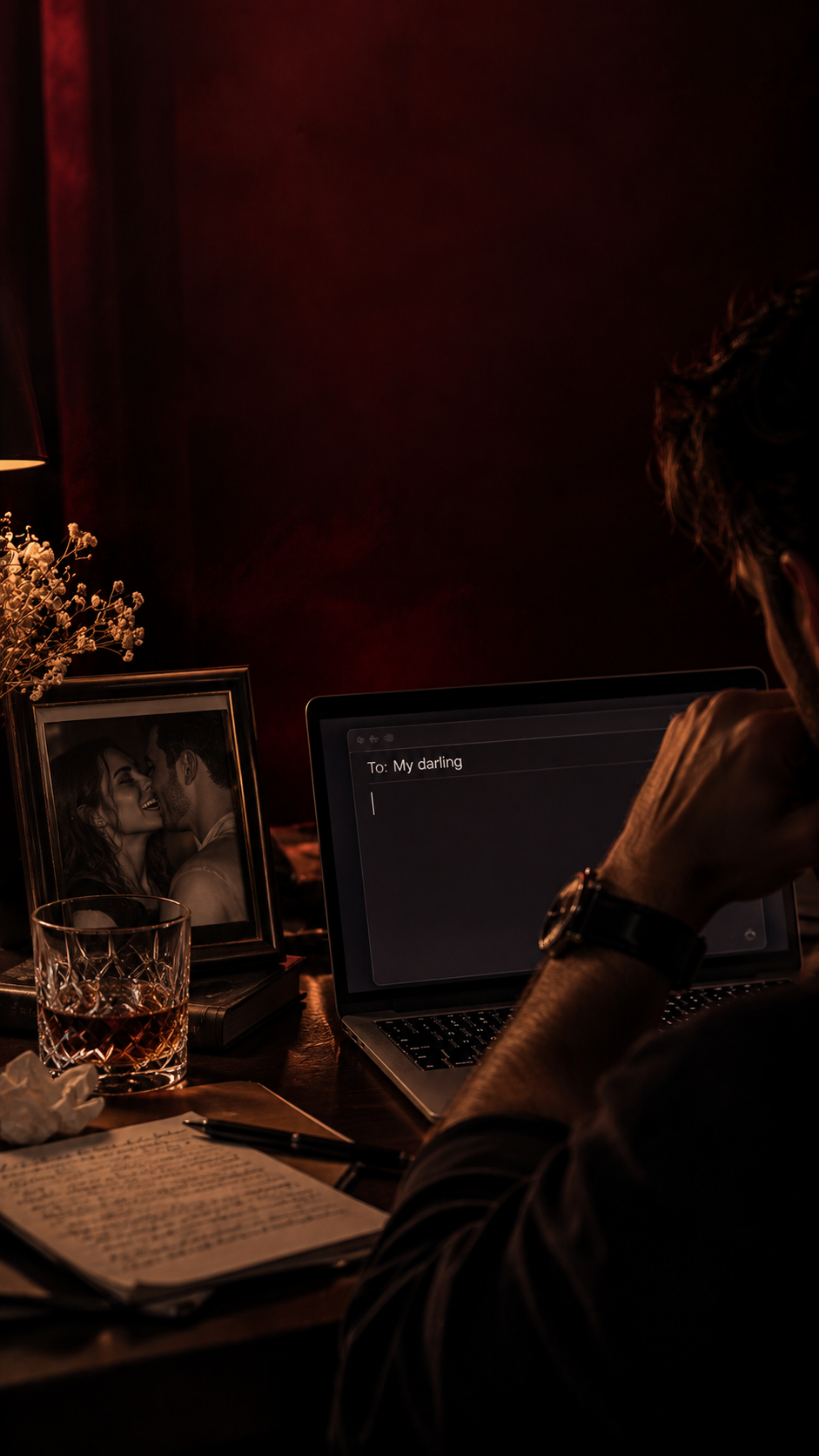
My Darling – Chapter 2 – Stop Looking At Me Like That
My darling,
I’ve been thinking about the coffee.
Yes, yours. No, this isn’t an apology.
You start bringing me coffee in October, which nobody asks you to do, and which you get wrong nearly every time, and I’ve come to suspect the wrongness is the actual point.
The first time it’s too much sugar. I mention it, not unkindly, more like a fact reported in passing, and you nod like you’re taking the note seriously.
The next day it’s too much milk instead.
The day after that it’s black, nothing added, which I also didn’t ask for, and when I raise an eyebrow you tell me I said I didn’t want sugar or milk, which is technically true and clearly beside the point, and you know it’s beside the point, and that’s the first morning I understand you’re doing this on purpose.
You don’t deny it when I say so. You just look pleased with yourself, which is somehow worse than a denial would’ve been, and you tell me you like watching me drink something I don’t like and pretend it’s fine – that I have a very specific face for it.
I tell you I don’t have a face.
You tell me I have several, and that’s one of them.
I don’t bring it up again after that. Partly because there’s no way to keep arguing it without confirming you’ve won, and partly because – and I don’t look at this too closely at the time – I’ve started looking forward to whatever’s wrong with it on a given day.
You’re good at the work, which surprises me more than it should.
I’d filed you, somewhere in the first month, under enthusiastic, will learn.
By November I have to move you to a different drawer. You catch a scheduling conflict on the Winslow files that I miss entirely, because I’ve done that exact task for six years and stopped actually reading it, and you catch it because you’re still reading everything like it might matter.
You don’t make a thing of it.
You just point at the line, quiet, almost apologetic about being right, and I look, and you are, and the only thing I manage to say is good catch, flat, because I don’t yet know how to say it any other way.
You grin like I’d said something generous.
We start eating lunch at the same time without either of us deciding to.
I notice this before I let myself think about what it means. You get up around 12:15 most days, and around 12:16 I find a reason to get up too, and we end up at the same table in the break room by the still-broken coffee machine, and you complain about your landlord, or a group project from your night classes, or the man two floors up who microwaves fish like it’s a personal statement.
I mostly listen.
Occasionally I say something dry enough to make you put your fork down.
You tell me once that I’m funnier than I let on, like it’s an accusation. I tell you I let on plenty. You say I let on maybe thirty percent, and that you’ve done the math. I ask how you measure a thing like that. You say you measure everything, it’s a personality flaw, ask anyone.
I start noticing things I have no real business noticing.
You tuck your hair behind your left ear but never your right, like the right one refuses on principle.
You say okay three times fast right before you’re about to disagree with someone, like you’re trying to sound agreeable before you contradict them.
You check the elevator around 8:52 every morning, and it takes me an embarrassing number of weeks to realize I’ve started doing the same thing, telling myself it’s about a meeting that isn’t for another hour.
I don’t say any of this out loud.
I’m not an idiot.
There’s a decade between us in age and an org chart between us in title, and there’s a version of this where I say something and it goes badly and you have to sit near me for the next two years feeling strange about it.
I decide, privately and with what I think at the time is real conviction, that this isn’t going to be that.
You make that conviction difficult to hold onto.
You start finding reasons to stand at my desk. You lean on the edge of it in a way that isn’t accidental.
You ask me questions you already know the answer to and watch me answer them anyway, with an expression I can’t fully name – amused, or something sitting just underneath amused.
Once, in December, you catch me looking at you a second too long across the conference table during a meeting that has nothing to do with either of us, and instead of looking away like a reasonable person, you hold it.
Just – hold it, long enough that I’m the one who has to break it first, and when I do, you go back to your notepad smiling like you’ve won something.
I tell you afterward, once the room is empty and the projector’s still humming, to stop looking at me like that.
You ask like what.
You know like what, I say.
You tell me you genuinely don’t, that I should educate you.
Like you’re keeping score, I say.
You consider that with the seriousness of someone weighing actual evidence, and admit you might be keeping score. You tell me I’m just always losing, so I’m the one who notices.
I tell you I’m not losing anything.
You say I checked the elevator four times that morning.
I don’t have an answer for that.
You know I don’t.
You pick up your notepad and walk out, unhurried, and I stand there in an empty conference room feeling exactly as caught as I am – and underneath the mortification there’s something else, something warm and inconvenient, that I spend the entire walk back to my desk trying, and failing, to talk myself out of.